Understanding Abstract Expressionism: A Beginner’s Guide
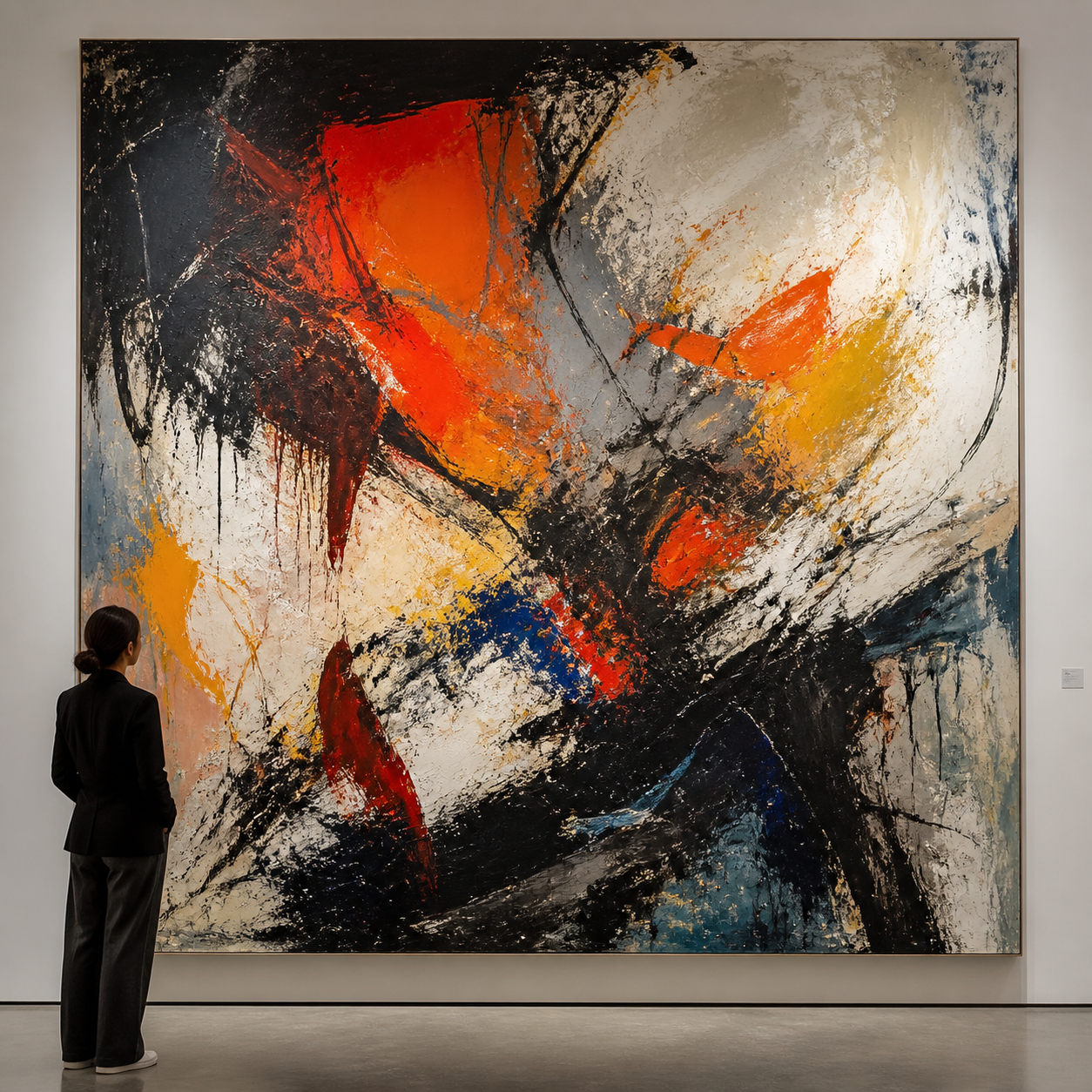
Abstract Expressionism can seem difficult at first. Its paintings may lack recognizable objects, yet they often communicate through movement, color, scale, texture, and the visible record of the artist’s decisions. For beginners, the most useful starting point is to see the movement as an exploration of emotion through abstraction, rather than as an attempt to depict a particular scene.
What Is Abstract Expressionism?
Abstract Expressionism is a postwar American art movement that used non-representational forms, expressive gestures, and expansive compositions to convey personal feeling and artistic experience. The movement emphasized the act of painting as much as the finished image.
Unlike a traditional portrait or landscape, an Abstract Expressionist painting may not ask you to identify a person, place, or event. Instead, it invites you to notice how paint behaves. A sweeping line can suggest speed; a dense surface can feel tense or concentrated; a broad field of color can create stillness or contemplation.
The movement brought together two related ambitions. Artists wanted to free abstract art from recognizable imagery, and they wanted the painting to retain evidence of the individual who made it. Brushstrokes, drips, revisions, stains, and gaps in the surface could all become meaningful.
This does not mean the work was random. Improvisation and spontaneity mattered, but artists developed highly controlled relationships between gesture, balance, rhythm, and scale. A painting might look immediate while reflecting extensive decisions about where to add, remove, repeat, or stop.
When and Where Did Abstract Expressionism Begin?
Abstract Expressionism emerged in the United States during the 1940s, especially in New York, and became a defining force in postwar American art. Its development helped establish New York as a major international center of modern art.
The movement grew from several converging conditions. European artists fleeing war brought ideas associated with Surrealism, abstraction, and psychological automatism to the United States. American painters absorbed these influences while searching for a distinctly contemporary language after the upheaval of World War II.
New York’s galleries, museums, studios, and informal artist communities created an environment for experimentation. The term New York School describes this broad circle of painters, although it was never a single, uniform style or organized school with one shared method.
Abstract Expressionism also reflected the changing possibilities of the American canvas. Artists worked on an ambitious scale, sometimes producing paintings large enough to surround the viewer’s field of vision. This scale shifted attention away from a small window onto the world and toward an immersive physical encounter.
For a reliable historical overview, the Metropolitan Museum of Art’s discussion of Abstract Expressionism places the movement within the wider history of twentieth-century art.
The Two Main Approaches: Action Painting and Color Field Painting
Action Painting centers on energetic gesture and the physical process of applying paint, while Color Field painting uses broad areas of color to create atmosphere, depth, and emotional intensity.
Action Painting
Action Painting is associated with movement, improvisation, and visible physical effort. Artists might drip, pour, fling, scrape, or rapidly brush paint across the canvas. The resulting marks often record the artist’s body in motion.
Jackson Pollock is the best-known example. In his poured paintings, the canvas could lie on the floor while paint moved through gravity, wrist movement, containers, and chance. The lines do not form a conventional subject, but they create a dense network of rhythm and direction.
Willem de Kooning also used vigorous brushwork, although his work often retained traces of the human figure. His paintings show why Action Painting should not be reduced to splashing paint. Color, composition, revision, and the tension between abstraction and representation remain central.
Color Field Painting
Color Field painting generally favors quieter gestures and expansive areas of color. Rather than directing attention through a web of marks, artists create floating shapes, luminous stains, or large chromatic zones that can alter the viewer’s sense of space.
Mark Rothko’s paintings often consist of softly edged rectangles suspended within larger fields. Their apparent simplicity depends on subtle shifts in hue, transparency, proportion, and spacing. The effect may change as you stand closer or allow your eyes to adjust.
The distinction between the two approaches is useful, but it is not absolute. Many Abstract Expressionists combined vigorous brushwork with atmospheric color, and artists within the New York School developed individual methods that resist neat categories.
Key Abstract Expressionist Artists to Know
The most important Abstract Expressionist artists developed distinct visual languages, so learning a few names helps beginners recognize the movement’s range.
- Jackson Pollock: Known for poured and dripped compositions in which layered lines create all-over rhythms. His work makes the painting process highly visible.
- Mark Rothko: Associated with Color Field painting, Rothko used large, softly bounded rectangles to create meditative relationships between color and space.
- Willem de Kooning: Combined forceful brushwork, fractured forms, and recurring images of the figure. His paintings move between recognizable imagery and abstraction.
- Lee Krasner: Developed dynamic collages and densely worked paintings, demonstrating the importance of revision, fragmentation, and recombination within the movement.
- Franz Kline: Used bold black-and-white forms that resemble energetic architectural or calligraphic structures, even though they do not function as literal drawings.
- Barnett Newman: Explored large fields of color interrupted by narrow vertical bands, which he called “zips.” These works depend on scale, intervals, and the viewer’s embodied experience.
These artists should not be treated as variations of one formula. Pollock’s physical networks, Rothko’s atmospheric fields, and de Kooning’s unstable figures demonstrate how broadly Abstract Expressionism could operate.
Common Techniques and Visual Characteristics
Abstract Expressionist techniques include dripping, pouring, layering, staining, scraping, and vigorous brushwork, often presented on large canvases with non-representational forms. These methods connect the final surface to the artist’s physical and emotional process.
- Dripping and pouring: Liquid paint creates lines, pools, splashes, and unexpected overlaps. Gravity and movement become part of the composition.
- Layering: Artists build surfaces through repeated applications of paint, allowing earlier marks to remain visible or partially concealed.
- Visible brushwork: Direction, pressure, speed, and the shape of a brushstroke can communicate energy without depicting an object.
- Large scale: A broad canvas can make color and gesture feel physical, surrounding the viewer rather than functioning as a small image.
- Contrasting colors: Opposing or sharply separated hues can produce vibration, tension, depth, or visual heat.
- Non-representational forms: Lines, stains, blocks, and organic shapes may suggest emotion or bodily experience without naming a subject.
One common mistake is to assume that an abstract surface contains no structure. Look for recurring marks, areas of pressure and release, visual pauses, and relationships between crowded and open spaces. Choosing to focus on technique reveals process, but it should not prevent you from considering mood and meaning.
How to Look at an Abstract Expressionist Painting
To look at an Abstract Expressionist painting, begin with direct observation, then examine composition, movement, texture, color, scale, and your emotional response before forming an interpretation.
- Start with the whole image. Stand far enough away to notice the overall balance. Does the painting feel concentrated in one area, or does the composition spread evenly across the surface?
- Trace the movement. Follow lines, drips, brushstrokes, and edges with your eyes. Notice where your attention accelerates, stops, or changes direction.
- Study the texture. Look for thick paint, thin stains, exposed canvas, scratches, or transparent layers. These details often reveal how the work was made.
- Consider color relationships. Ask whether colors blend, collide, recede, or appear to glow. A quiet palette can feel intense, while bright colors can produce unease.
- Test the effect of scale. Move closer, then farther away. At close range, you may see material and gesture; at a distance, the painting may become an environment or an atmosphere.
- Separate observation from speculation. First say what you can verify: “a black line crosses a pale field.” Then ask what that relationship suggests to you.
There is no single correct emotional response, but interpretations still need evidence. If a painting feels anxious, peaceful, crowded, or weightless, connect that response to specific features such as compressed space, repeated diagonals, soft edges, or dominant color.
Why Abstract Expressionism Still Matters
Abstract Expressionism still matters because it makes artistic choice, experimentation, and individual perception central to the viewing experience. Its paintings continue to challenge assumptions about what a picture must represent.
The movement also rewards slow looking. In a gallery, a work may appear simple from across the room and become increasingly complex as you notice faint layers, altered strokes, uneven edges, or changes in color temperature. The encounter unfolds over time.
Abstract Expressionism remains influential in contemporary painting, installation, performance, and other forms of visual art. Artists still explore scale, bodily action, chance, material surfaces, and the expressive potential of color.
For beginners, the movement offers a practical lesson: understanding does not require decoding a hidden picture. Begin with what the painting does. Watch how it occupies space, controls attention, and turns material decisions into an experience.
Frequently Asked Questions
Is Abstract Expressionism completely non-representational?
No. Some Abstract Expressionist works are fully abstract, while others retain figures, body parts, landscapes, or symbolic forms. Willem de Kooning’s paintings, for example, often move between recognizable imagery and abstraction.
What is the difference between Action Painting and Color Field painting?
Action Painting emphasizes energetic marks and the physical act of applying paint. Color Field painting emphasizes large areas of color, subtle transitions, and atmospheric or contemplative effects. Individual artists may combine both approaches.
Why are Abstract Expressionist paintings often so large?
Large canvases support sweeping gestures and allow color to surround the viewer’s field of vision. Scale also turns viewing into a bodily experience, although not every Abstract Expressionist artist worked on monumental surfaces.
Who are the most important Abstract Expressionist artists?
Key figures include Jackson Pollock, Mark Rothko, Willem de Kooning, Lee Krasner, Franz Kline, and Barnett Newman. Their different methods show that the movement included both energetic Action Painting and restrained Color Field painting.
How should beginners interpret abstract art?
Begin with careful observation. Describe composition, movement, texture, color, and scale before discussing emotion or symbolism. Your response can be personal, but a strong interpretation explains which visible features support it.